Investigations
Under a Little-Known Treaty, Foreign Nationals Incarcerated in Illinois Can Ask for Transfers to Their Home Countries. Very Few Are Approved
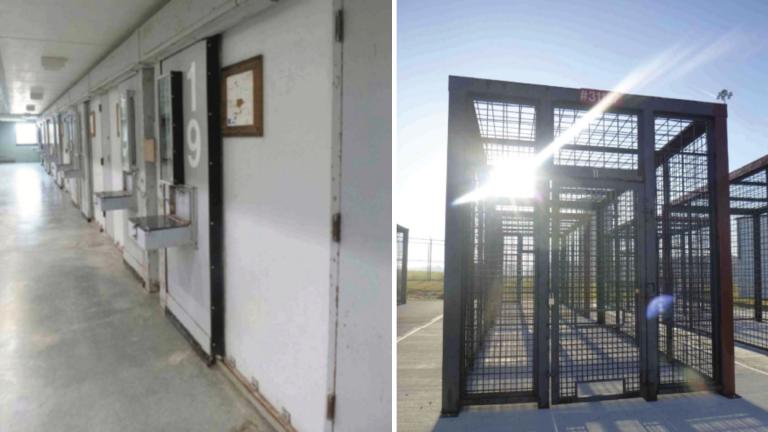
 Prison cells and bars are shown in a file photo. (txking / iStock)
For the past nine years, Manuel Cervantes has been applying to transfer out of the Illinois prison where he’s incarcerated.
But he’s not looking for release; he’s applying to transfer to a prison in Durango, Mexico.
“My parents are close to 80 years old now; their health is not the best,” Cervantes said on a call with WTTW News, noting he wants to finish his sentence in Mexico so he can spend more time with his parents. While his parents do visit him in Illinois, he said a transfer to Mexico would be better for his family.
Cervantes, a Mexican national, has applied for a transfer through the little-known International Prison Transfer Program. It began in 1977, when the U.S. and Mexico signed a treaty that allows for citizens incarcerated in either country to apply to transfer to a facility in their home country. Since that first treaty, more than 80 other countries have signed their own treaty with the U.S.
Cervantes is still waiting at Dixon Correctional Center after having been denied transfer six times.
Over the past five years, 59 petitions have been filed with the Illinois Department of Corrections from those incarcerated in Illinois state prisons requesting transfers all over the world: Albania, Bosnia, Bulgaria, Canada, China, France, Ghana, Honduras, Mexico, Norway, Poland, Russia, Sierra Leone and the United Kingdom.
Yet during this period, only two people have been approved, and two more are pending, according to the Illinois Department of Corrections.
 Manuel Cervantes poses with some of his artwork. (Courtesy of Stephanie Matthews)
When asked about Cervantes’ case and the department’s transfer process, IDOC spokesperson Naomi Puzzello said she could not comment on the transfer requests of an individual in custody, as requests and determinations are confidential. The department does not maintain an estimate of individuals who may be eligible for transfer, she added.
Illinois is not alone in issuing denials with a heavy hand. In 2013 — the most recent publicly available data from the federal government — an estimated 24,122 people across the country requested transfers from the Federal Bureau of Prisons, including 22,700 that the bureau deemed ineligible and 1,422 that the agency determined eligible and forwarded to the International Prison Transfer Program for further review. However, just 245 people were transferred that year.
When asked about the number of requests and denials, a spokesperson for the International Prison Transfer Unit emphasized that they only received those 1,422 requests that the Federal Bureau of Prisons determined eligible, and that “245 transfers out of 1,422 is very different than 245 transfers out of 24,122.”
“It is very frustrating, because I see so many people that languish in our jails, and it’s also costing the taxpayer a lot of money and yet it does does not fulfill the purpose of these treaties,” said Bruce Zagaris, an attorney with Berliner, Corcoran and Rowe.
Zagaris has written at length about the process and has represented multiple incarcerated people during their international transfers.
At a time when the federal government is deporting people at historic highs, Zagaris said there still hasn’t been a willingness to allow incarcerated people to finish their sentence in their home country.
While this process is usually used by those in the custody of the Federal Bureau of Prisons, those in state prisons can also apply.
The treaty’s purpose is to aid a person’s reintegration into society upon release and save on costs for institutions. Cervantes said he’s applying to complete the last 21 years of his sentence for aggravated criminal sexual assault and aggravated kidnapping in Mexico to receive more frequent visits from family.
To apply, Cervantes sent a letter expressing why he thinks he should transfer to a Mexican prison to the Illinois Department of Corrections’ Office of the Transfer Coordinator. Pending IDOC’s approval, Cervantes would need to get the OK from the U.S. Department of Justice, its Criminal Division’s Office of Enforcement Operations’ International Prison Transfer Unit and Mexican officials.
But Cervantes has never gotten past the first step: approval from the state.
Each of his six applications since 2017 has been denied with his most recent denial in 2024. With each denial, he’s told he has to wait a year to reapply. All of his applications are met with nearly the same statement that reads, in part: “Please be advised, your information has been reviewed and it was determined you are appropriately placed at this time.”
“It was very, very frustrating,” Cervantes said. “The first (denial), …. the second year denied, the third year denied, I was like, ‘Oh my God, what’s going on.’”
This short and unexplained response is common in the denials Zagaris has seen.
A 2011 report from the U.S. OIG found that federal applicants generally did not understand why transfer requests were denied by the International Prison Transfer Unit and were therefore limited in their ability to successfully reapply. The unit then revised its denial letters to state that the applicant could write to seek more specific information about the denial reasons.
The most recent report from the U.S. OIG in 2015 left the agency “concerned” that the DOJ was not fully utilizing its transfer authority. While the report did not evaluate why exactly the transfer numbers were so low, it acknowledged possible issues could be people preferring to serve sentences in the U.S. or nationals who are not from treaty-eligible nations.
The report also found issues specific to Mexican transfers.
Mexico, it found, was especially reluctant to approve transfer requests their nationals made and the DOJ approved. Mexico has consistently defended its low approval rate as a response to overcrowded prisons and the need to reject inmates who will threaten prison security, the report continued.
A person might be transferred if their language isn’t as commonly spoken or their religion might not be practiced in a U.S. facility — but that argument typically isn’t made for Mexicans, Zagaris said.
“Mexico is sometimes a special case … because a lot of Mexicans are, before they’re prosecuted, have already spent a lot of time in the United States, and so sometimes the U.S. feels that they’re not really that much foreigners,” Zagaris said.
There are additional requirements for the treaty between Mexico and the U.S. that can reduce the pool of eligible candidates: It precludes those serving immigrant, life, military or political offenses and those who have become domiciliaries of the sentencing country, meaning the person has been present in that country for at least five years with the intent to remain.
That’s on top of general eligibility requirements for the program: the petitioner be a national or citizen of the country they wish to transfer to; that there be a transfer treaty relationship between the two countries; the petitioner must be convicted and sentenced without ongoing appeals; that there be a reciprocal criminal status in the receiving country; that at least six months of the petitioner’s sentence remains to be served at the time of the petition; and that the petitioner, sentencing and receiving countries must consent to the transfer.
Cervantes’ attorney, Stephanie Matthews, said Cervantes has met both the general program and Mexican requirements to transfer.
“There’s no reason not to transfer him,” Matthews said. “I think it’s a shame that the Illinois taxpayers are paying to house people who could be in a prison in their native country, near their families.”
Time is going by slowly for Cervantes as he waits for a response from officials. His lawyer said she recently sent a petition to Gov. JB Pritzker to reconsider the denials of six previous requests. Cervantes subdues his anxiety by oil painting, most recently one of a Native American person riding a horse for his mother.
Contact Blair Paddock: @blairpaddock.bsky.social | [email protected]