

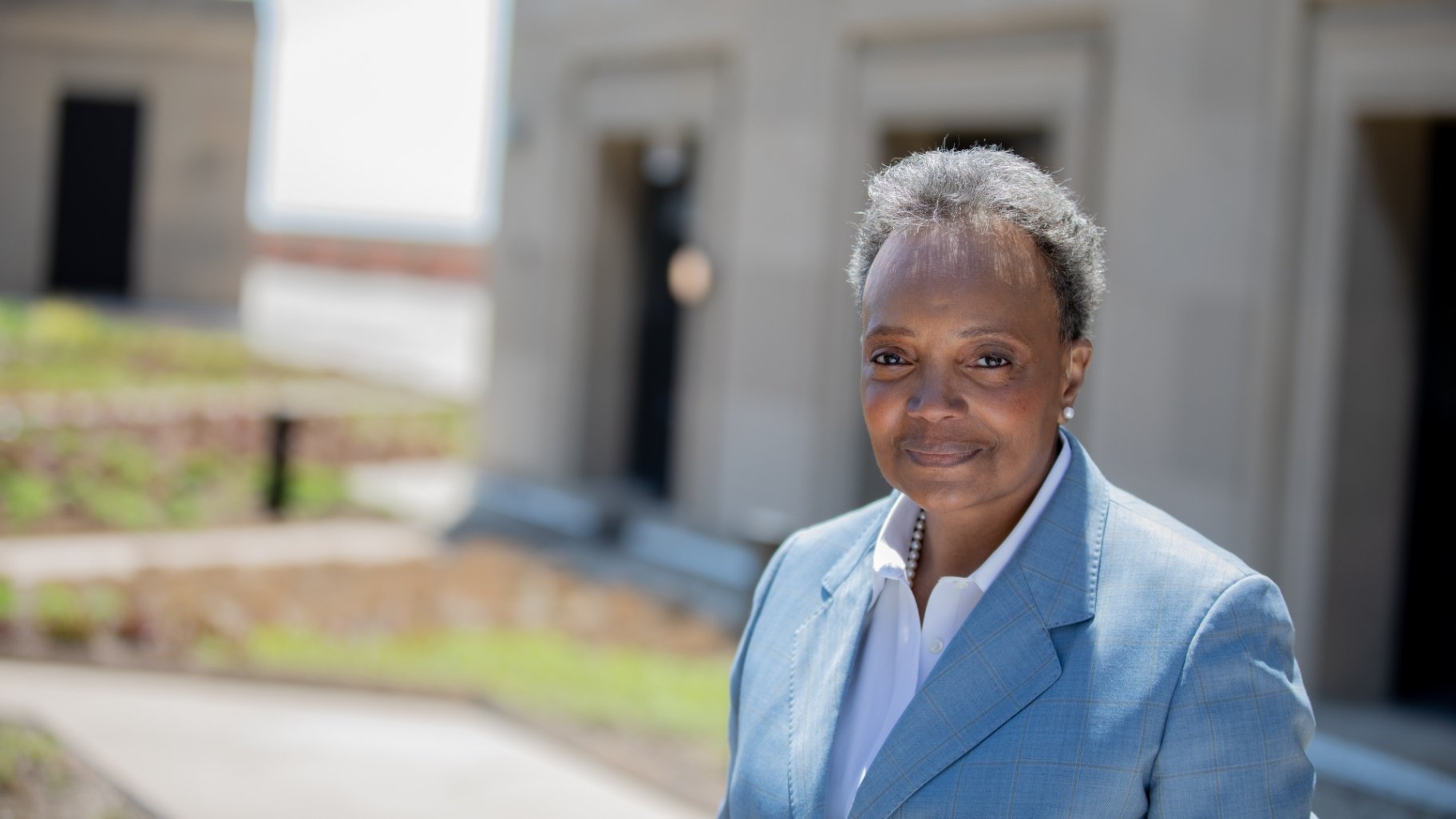
About the Candidate
Name: Lori E. Lightfoot
Date of Birth: Aug. 4, 1962
Occupation: Mayor of Chicago
Political Experience: Since May 2019, I have served as Mayor of Chicago. Before becoming mayor, I worked as a lawyer, police reform expert, and experienced manager of city departments. I was the Chief Administrator of the Office of Professional Standards at the Chicago Police Department, Chief of Staff and General Counsel of the Chicago Office of Emergency Management and Communications, and Interim First Deputy at the Chicago Department of Procurement Services. I was also appointed to serve as President of the Chicago Police Board, as well as Chair of the Police Accountability Task Force.
Political Party: Democrat
Website: lightfootforchicago.com
Candidate Q&A
Why are you running?
Residents elected me to take on the tough challenges we face as a city and to destroy the status quo and remnants of machine politics that held too many of our communities back. Despite historic challenges emanating from a global pandemic and all of its cascading consequences, we have persevered and built a Chicago that is stronger and more equitable than ever. We have not been perfect in our work, but we have been humble in our efforts and execution, and we have learned from mistakes and worked to do better and better every day.
I have unapologetically undertaken an ambitious agenda of expanding opportunity and inclusive economic growth across Chicago’s neighborhoods and communities, leading the city through the unprecedented challenges of a global pandemic with tough, fair, and transparent leadership while keeping the promises I made to Chicagoans during my campaign. I am proud of the work that we have accomplished and the things that we have delivered for Chicagoans.
From building an economy that is flourishing; to unmatched fiscal stewardship of precious taxpayer dollars; to our neighborhood investments; to our focus on public health and health equity; to historic investments in the environment, affordable housing and our youth and their families; to public safety and police reform and accountability—we have raised the bar for excellence, good governance, and what it means to reflect the lived experience of individual residents in the work of government.
We raised the wages of hundreds of thousands of workers, made unprecedented investments in our neighborhoods, and are making robust investments in community-based violence prevention and law enforcement to build a safer Chicago. Together, we’ve taken on the big fights and entrenched power structures—but we still have a lot of work to do, because change just doesn’t happen overnight.
Serving as the 56th mayor of this great city has been the honor of a lifetime. I’m running for re-election to finish what we started and to continue to make our city safer, fairer, and more equitable for all.
What does this office do well, and what needs fixing?
We have been nimble and flexible in the face of unimaginable challenges, from the COVID-19 pandemic to historic civic unrest to long-standing public safety issues. Our administration has been able to shift gears and reallocate our focus and resources to address unexpected crises—and that's a testament to our not being afraid to make tough choices and do the right thing in tough circumstances.
Our work will not be complete until Chicagoans in every corner of our city feel safe in their neighborhoods. While we have made important progress on this journey, I will never be satisfied until we are the safest big city in the country.
What is the most pressing issue facing your constituents and how do you plan on addressing it?
Public safety is the most pressing issue facing our city. We are on the right path, but individual residents have to feel the benefits of our progress, and there we have more work to do.
Change takes time, but we are seeing progress in reducing violent crime and seeing the results of our community investments. In 2022, shootings were down 20% and murders were down 14%. We will keep tackling gangs, getting guns off of our streets, and holding violent, dangerous offenders accountable, while making historic investments in the communities that suffer the most from violence.
I know that many Chicagoans still don’t feel safe, and we will continue to work tirelessly to ensure all residents feel a sense of security in their communities.
What specific steps would you take to ensure your office is accessible and responsive to your constituents?
I am proud of the work our administration has done to improve accessibility and responsiveness across city government. We have been intentional about listening to Chicagoans from all walks of life to inform our priorities and policies. For instance, my administration established five community engagement councils so our city could better serve our immigrant communities.
We also expanded our advisory councils (which range from The Veteran's Advisory Council to The LGBTQ+ Advisory Council) to improve the representation of our diverse populations in policymaking. Prior to the passage of our $16.4 billion budget for this year, we conducted three budget engagement forums across the city to have conversations with residents about what they wanted to see prioritized in our spending plan.
The feedback we received from residents and community stakeholders was vital in shaping this year’s city spending.
We have also pushed a significant amount of city data online to make it more readily accessible so residents can see in real-time how our city government is functioning. In the Mayor’s Office alone, we have responded to over 2,300 Freedom of Information Act requests and counting during my tenure—a far higher number than any previous administration.
We have a dedicated team whose job is exclusively to handle the high volume of requests with fidelity. We have made important strides on our journey of making city government more accessible and responsive to Chicagoans, and I am looking forward to making further progress on this in another term.
Do you believe in the tradition of aldermanic prerogative, which gives each City Council member the final say on issues in their ward?
I value the insight of local aldermen, but they shouldn’t have an unchecked veto over economic development and affordable housing. That’s why I took historic action on aldermanic prerogative during my first 100 days in office. We are eager to pass additional legislation on this endeavor as part of our work to build a more prosperous and inclusive Chicago.
Should the $1.9 billion budget for the Chicago Police Department increase, stay the same or decrease?
I support the $1.94 billion budget for the Chicago Police Department we passed as part of my 2023 spending plan. This budget was a $63 million increase over the 2022 budget for the department and set aside funding for our recruitment and retention efforts, two new police helicopters, new technology and equipment for our officers, as well as resources to meet our consent decree obligations. In future years, we will similarly adjust our budgets accordingly to align with our staffing, facility, and equipment needs for the department.
Should the city raise the Real Estate Transfer Tax on properties sold for more than $1 million to fund programs to help unhoused Chicagoans?
My administration has made historic investments to help unhoused Chicagoans. We are advancing a comprehensive set of solutions to combat both homelessness and housing instability.
For example, our 2023 budget increased funding for homelessness support services, with $200 million dedicated to investments including rapid rehousing programs, the development of permanent supportive housing, non-congregate housing programs, low-barrier shelter, and additional positions for our homelessness services team. I am open to exploring other revenue sources to address homelessness that takes into consideration housing and services.
Should the city open and operate mental health clinics to provide free care to Chicagoans?
City mental health services were abysmal when I took office—but that has changed under my administration. We dramatically expanded access to mental health care across our city. Since 2019, we have had an equity-based, culturally competent citywide continuum of care system that is providing mental health care across all of our city’s communities.
I am proud to have increased mental health funding more than sevenfold since the previous administration, from $12 million in 2019 to $89 million in 2022. Sixteen times more Chicagoans receive mental health care annually from us compared to when I took office, and we are now funding resources in all 77 community areas.
We have made sure that the full range of mental health services is available without regard to insurance, ability to pay, or citizenship status. This is incredibly important to me personally, and I also feel strongly that it is an important component of our citywide plan to make Chicago safer and address the root causes of crime and violence.
How should Chicago build the 120,000 homes it needs for low- and moderate-income Chicagoans?
My administration has prioritized unprecedented investments and zoning reforms to build affordable housing across our city. We know the construction of affordable and accessible housing for Chicagoans from all walks of life is not just a vital step in our mission to fight homelessness and housing instability, but it's also a means of building more prosperous and vibrant communities.
That’s why, under my leadership, we are placing the largest single investment in affordable housing in city history, pledging more than $1 billion to build new and preserve existing homes across the city. The city is addressing rapid development and gentrification to prevent the displacement of long-time residents through our revision of the Affordable Requirements Ordinance. The ordinance creates much-needed affordable housing throughout Chicago and helps address the legacy of racial segregation. Additionally, our administration has been a vocal supporter of accessory dwelling units (ADUs) to promote naturally affordable units across Chicago. I passed an ordinance ending the city’s ban on the construction of new ADUs, which had been in place since 1957. We approved hundreds of applications for new ADUs in the first few months of our ADU pilot program, and I am eager to expand the program. Affordable housing for low- and moderate-income Chicagoans is also a key component of my INVEST South/West initiative, which, to date, through a pandemic and resulting economic meltdown, has mobilized more than $2.2 billion in public and private investment commitments in 10 South and West Side communities.
We’re working with the Reclaiming Communities Joint Venture to build 250 single-family homes on vacant city-owned lots in North Lawndale (the city is helping catalyze this development by selling the 250 lots for $1 each and providing over $5 million in TIF and Chicago Recovery Plan funds for site remediation and lot preparation). We’re also working with Inherent Invest Homes to build new single-family homes on city-owned lots in Humboldt Park for working families. The first and second floors of these homes will be constructed wholly in Inherent’s modular home production facility on the West Side, marking the first time the City of Chicago has been involved with this type of modular housing.
Lastly, our work to fight aldermanic prerogative has been essential in increasing the supply of housing for low- and moderate-income Chicagoans. For example, we secured the approval of an apartment development on the Far Northwest Side near the CTA Blue Line despite the local alderman’s strong objections. That development will include 297 apartments just two transit stops from O’Hare Airport, 20% of which will be affordable. Additionally, our groundbreaking Connected Communities Ordinance limits the ability of aldermen to block the development of new housing near public transit in areas that lack affordable housing. We are eager for further reforms to build walkable, affordable, and thriving communities connected to transit across Chicago—including by further protecting existing affordability in transit-rich communities. We believe in the importance of local input, but we believe the input should be focused on how we create more housing, not if we create more housing for Chicagoans.
What do you see as potential solutions to address the number of shootings in Chicago?
The most important responsibility of any mayor is public safety. My goal is to make Chicago the safest big city in the country by creating lasting peace, not just episodic periods of peace in certain neighborhoods. We must get to a place where every resident, regardless of where they live, feels safe because they are safe. There are no simple solutions, and anyone who suggests there are either does not understand the complexities of crime or is not being honest.
I spend much of my time in communities across our city, listening and learning from Chicagoans and implementing solutions driven by residents, as well as continuing to push for the execution of our larger strategies. In my experience, residents want to know that there is a plan that makes sense and is getting results and that their unique experiences and concerns are being heard.
Here’s our plan that we have been executing: we are taking a comprehensive approach to violent crime by tackling the scourge of illegal guns, holding violent dangerous people accountable, and investing in communities to address the root causes of violence.
The number one driver of violence in Chicago is the ready access to illegal firearms. There are no simple solutions to this problem, particularly in the absence of federal common-sense gun reform. There are, however, impactful, multi-tiered solutions we have and will continue to deploy at the local level such as the recently passed ban on assault weapons in Illinois. These weapons of war are a clear and present danger to Chicagoans.
We must continue to seek additional ways to stem the flow of illegal guns into our city. For this reason, we do not hesitate to hold gun dealers—whether in-state or out-of-state—accountable for illegal guns that end up on Chicago’s streets. For example, we sued Westforth Sports, Inc., a Gary, Indiana gun dealer responsible for a pattern of illegal gun sales that were used in crimes in Chicago.
We also need to continue collaborating with the Bureau of Alcohol, Tobacco, and Firearms (ATF) to take advantage of federal laws against gun trafficking and straw purchasing. I will continue to advocate for additional resources to the ATF’s Chicago field division.
In addition to these efforts, our strategy centers on stopping violent people who use guns before they strike, pressing the courts and prosecutors to hold these people accountable, and making investments that give people, especially young men of color, an entrance to the legitimate economy. In 2022, we made progress in this important mission of public safety, but we have many more steps in our journey.
We’ve made progress because we focused on accountability in every part of the public safety ecosystem—accountability for me as Mayor, CPD leadership and officers, as well as the prosecutors and courts. This has meant using data-driven strategies to determine weekly police deployments and make nimble adjustments as necessary, with a focus on CPD working with other law enforcement partners at the federal, state, and county levels, and other municipalities, as well as street outreach workers, to proactively stop crimes before they happen, cut off the cycle of retaliatory shootings, take illegal guns off the streets, and hold violent individuals accountable.
Toward this end, we continued our investments and commitment to police and public safety. We created the new CPD Gun Investigations Team in 2021 to interrupt the illegal flow of guns into the city with our federal partners, and to seize expired Firearms Owners’ Identification Cards and guns from individuals in Chicago who no longer can legally possess them. Every patrol district is also focused on seizing illegal guns. Last year, CPD removed more than 12,700 illegal guns from our streets, including more than 1,000 assault weapons and 750 ghost guns.
We secured a $63 million increase in the CPD budget for 2023, bringing the total budget to nearly $2 billion. We also continued our critical investments in officer wellness. CPD placed strict limits on canceled days off and imposed mandatory rest periods between shifts. In addition, CPD improved dated policies and procedures which facilitated the hiring of more than 950 new police officers in 2022, to keep pace with promotions and retirements, all amid a nationwide police staffing crisis. CPD also promoted nearly 300 new detectives.
CPD expanded the Vehicular Hijacking Task Force, which includes Chicago Police, Cook County Sheriffs, Illinois State Police, other regional municipalities, as well as federal law enforcement, to take on the increase in carjackings that Chicago and cities across the country have experienced in recent years. A retail theft task force that we stood up in the face of the summer 2020 looting remains active, collaborating with businesses and security personnel from commercial districts citywide and particularly in the Central Business District and along Michigan Avenue.
In August 2021, we constituted the Community Safety Coordination Center (CSCC) which coordinates public safety investments and responses both inside city government and with community partners. The CSCC convenes city personnel responsible for any aspect of public safety with emphasis on the reality that every city department—from infrastructure to public health, the Department of Family and Support Services, the Department of Housing, Business Affairs and Consumer Protection, schools, parks, libraries, etc.—has an integral role to play in community safety. City departments now understand that they must work together, not in silos, to bring a coordinated whole-of-city approach to public safety.
The CSCC has been focused on the 15 communities that historically experience almost 50 percent of violence. In all of these communities, we work with key stakeholders, and ask “what will it take for you to feel safe?” The answer differs in each community, but we work to capitalize on the assets and opportunities available, working hand in hand with the community.
My administration has recognized that after decades of what was, in essence, a law enforcement first and only strategy, we cannot just arrest our way out of the problem–but we can and we must couple strategic use of law enforcement with a targeted investment strategy to build our way to lasting peace. We have focused on the root causes of violence and treated the problem as the public health epidemic that it is. The CSCC plays a key role in building up community capacity through tangible investments.
For example, we have committed to unprecedented investments to support youth and their families, such as the Service Coordination and Navigation program, which connects youth to mental health services, housing, education, training, and legal services. We dedicated 50 percent of our summer jobs to at-risk youth, and we expanded funding for CPS initiatives like Choose to Change and Back to Our Future, two programs that provide paid employment, mental health services, and mentors for at-risk youth. To support families at the earliest stages of a child’s life, we have scaled up the Family Connects program in which an R.N., in coordination with obstetrics hospitals, makes in-home visits within two to three weeks of a baby being released home after birth to do a well-being check to assist the mother and the baby and, where needed, to connect the family to social services.
We expanded the Narcotics Arrest Diversion Program, which redirects people with substance use disorders away from the criminal justice system and into medical treatment and rehabilitation. We also spearheaded new supports for Chicagoans returning from prison that provide them with new, meaningful opportunities to prevent a return to a life of crime or recidivism. We launched the Crisis Assistance Response and Engagement pilot program to respond to 9-1-1 calls related to mental health crises. Response teams include specially trained paramedics, mental health clinicians, and police officers who have completed the city’s crisis intervention training.
In 2022, homicides dropped by 14%, shootings dropped by 20%, and carjackings by 10%. In the 15 communities which were the focus of the CSCC, we saw, on average, homicides drop by 24% and shootings by 25%. In addition, there has been a measurable reduction in violent crimes in entertainment districts in River North and Motor Row, due in part to crackdowns on local businesses, especially those with late-night liquor licenses.
The above is not an exhaustive list of all of the public safety investments or initiatives. We have more work to do, but given the hard, selfless work of so many across our city, it is important to note the progress made on this journey.
We must continue to focus on juvenile offenders. Rather than simply locking up juvenile offenders, we must give young people an off-ramp from criminal conduct through social services and other supports. This must be a part of the adjudication of their cases, and we will continue to push the courts to take a more holistic approach, rather than simply releasing these young people back to the streets without any meaningful intervention.
In addition, we saw an alarming spike in domestic violence-related homicides and shootings which drove the city’s violence statistics. These are tougher crimes to prevent and require deeper investments and collaboration with advocates and enhanced public marketing and engagement to help victims leave dangerous situations before a shooting or homicide occurs. We will also continue to press the criminal courts to do their essential part to hold violent people accountable pre-trial so that they do not continue to wreak havoc in our communities.