

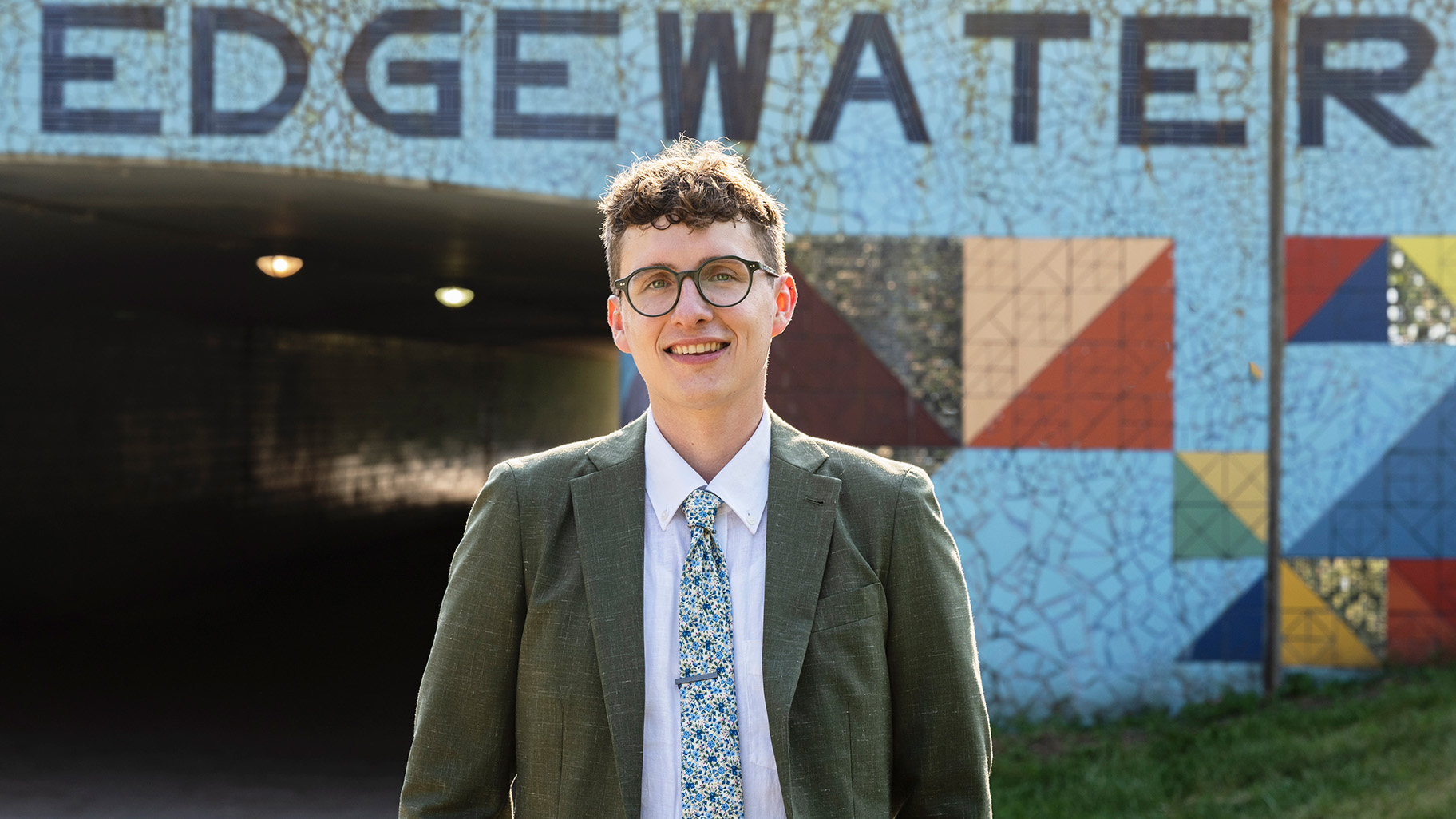
About the Candidate
Name: Larry Svabek
Date of Birth: 1993
Occupation: Lecturer and Fellow, University of Chicago
Political Experience: I was a member of the CPAC coalition (and then advocate for the Empowering Communities for Public Safety ordinance), organizing neighbors around public safety issues in our community.
Political Party: Democrat
Website: larryfor48.org
Candidate Q&A
Why are you running?
I am running to provide independent, progressive leadership to the 48th Ward. This election, Chicagoans have an exciting opportunity to elect new leaders who will help the City Council put away its rubber stamp and bring new energy and ideas to City Hall. We have big challenges in front of us. In this moment, we need leaders who are principled and will faithfully represent our communities, while also delivering meaningful results on the issues most important to us. As an educator and researcher, I will pursue data-driven solutions to tackle our city's biggest problems. As an organizer, I also know it is not enough just to know what the right solution is: we need leaders who are bold and unafraid to take action.
The aldermanic position is complex. Alderpersons must deliver efficient constituent services and have the policy skills to write legislation that strengthens and unifies our city. I have experience providing constituent service for a Congressional office and plan to update and democratize the office by establishing participatory budgeting and creating a series of community advisory councils to weigh in on decision-making.
I also know what it takes to build winning coalitions and pass new ordinances. I came of age during our nation’s reckoning with the problem of unchecked police violence against Black and brown citizens. The frequency of publicized killings at the hands of police officers spurred me to action. I organized with neighbors across Chicago’s North Side to translate the rising anger into substantive policy change. I co-founded a community group that worked with the Chicago Alliance Against Racist and Political Repression to educate neighbors about the Community Police Accountability Council (CPAC) ordinance.
As a member of the negotiations committee, I helped merge CPAC with the alternative coalition forming an ordinance that would create community councils for each police district and a city-wide commission to decide CPD policies and play a role in selecting CPD’s leadership. Together we steered the ordinance through the Council—creating the first ever civilian oversight in our city, ensuring that police officers are accountable to the communities that they serve. This experience taught me that passing progressive policies requires not only determination but also a willingness to compromise and bring new coalition partners to the table.
What does this office do well, and what needs fixing?
I believe that the strength of the current 48th Ward office is its responsiveness. I’ve talked to countless community members who appreciate the constituent service work that our current alderman provides. The next alderperson must continue that level of responsive and engaged service. I think the current city council has been fairly passive over the past few years and we need to elect leaders who are energetic and will fight for ordinances like Bring Chicago Home and structural change like reconstituting the Department of the Environment if we want to make real progress on the issues that matter to us.
Problems ranging from slow replacement of lead pipes to reliability and safety concerns on public transit require stronger oversight of governmental departments. When the city fails to address these issues, it hurts our communities. I am running to ensure that we have leaders who will stand up for the city council’s independence from the mayoral office and actively pursue a bold, legislative agenda.
What is the most pressing issue facing your constituents and how do you plan on addressing it?
I helped pass the Empowering Communities for Public Safety (ECPS) ordinance which democratizes public safety decision-making. As a result, for the first time ever, neighbors will elect community representatives to collaborate with each police district, and allow neighbors more say in public safety policy and decision making. As Alderman, I will work closely with police district councilors to engage our community and invest in programs to prevent crime.
I am also a proponent of investing in “positive activity” such as nighttime programming to increase foot traffic, making transit and streets safer. Right now, our public safety system asks police officers to respond to every kind of crisis. We need to expand our mental health crisis responders program so that mental health professionals and social workers respond to certain crisis calls. In addition to expanding our response teams, I will fight to pass the Anjanette Young Ordinance, banning unnecessary and harmful no-knock warrants.
What specific steps would you take to ensure your office is accessible and responsive to your constituents?
Community engagement starts with keeping neighbors informed about happenings that affect our community. I appreciate Alderman Osterman’s weekly newsletter; I would continue to send a comprehensive weekly newsletter and would work to build our office’s newsletter list to include even more ward residents. I would also regularly flyer residents to inform them about events in their area in order to make sure that all members of our community, including renters in large buildings, have access to information regardless of whether they’ve previously connected with our office.
Strong engagement also involves continuing to utilize the strength of institutional networks in our community, so I would seek to reach neighbors by asking our many neighborhood associations, schools, and social service providers to assist in disseminating information. Beyond keeping the community informed, I would work to provide clear channels through which neighbors can provide perspective, feedback, and ideas about the broad range of issues affecting our community. I plan to build an advisory council for each major policy area: economic development, environment, public transit, public safety, culture and the arts, and zoning. I would fill those councils with candidates from different parts of the ward to ensure appropriate representation.
I also plan to bring participatory budgeting to the ward to direct our use of infrastructure funds. My office would prioritize efficiency, equity, and proactiveness to respond to requests. I would use technology and data to track requests, schedule regular follow-ups, and identify broader patterns that we must address holistically. For example, we can map flooding complaints across the ward, and then work collaboratively with the Department of Water Management to address persistent areas of concern.
Do you believe in the tradition of aldermanic prerogative, which gives each City Council member the final say on issues in their ward?
I think we need to limit aldermanic prerogative without losing sight of the need for community input. In many ways, each alderperson is better situated than their colleagues to make zoning and development decisions about their ward because they are closer to the community most impacted by those decisions. They have regular interaction with and are accountable to the residents of their ward. Far too often, however, developers are able to dictate the terms of zoning and development, leading to decisions that are not in the best interest of residents.
We need to balance these two competing realities by allowing some checks on aldermanic prerogative as well as democratizing the local aldermanic office by creating a rigorous, community-driven zoning and development process so that a more diverse body of constituents weigh in on development and zoning matters.
Should the $1.9 billion budget for the Chicago Police Department increase, stay the same or decrease?
When you include pensions, legal settlements, and fleet management, CPD cost the city over $3 billion dollars last year. The Chicago Police Department--which continues to fail to meet consent decree benchmarks--should be providing effective, innovative, and equitable public safety programming for that amount of money. I support the UChicago Crime Lab's reallocation model to better utilize the resources already committed to CPD.
I also believe that CPD should be responsible for training their officers in de-escalation techniques that don't require use of force and investing in data-driven violence prevention measures that attack the root causes of crime. I will also fight for a diverse array of emergency responses so that mental healthcare and social worker response teams are deployed to certain kinds of crisis calls.
Should the city raise the Real Estate Transfer Tax on properties sold for more than $1 million to fund programs to help unhoused Chicagoans?
Chicago ranks 10th out of 11 cities with the largest homeless populations for spending per homeless person. Since the COVID pandemic began, our city has witnessed a 13% increase in the number of unhoused residents. Our community experiences these statistics everyday. We need an annual revenue source for permanent supportive housing if we want to address the homelessness crisis. I support Bring Chicago Home and will work with my colleagues to find revenue sources that can meet our city's needs. Any plan to address homelessness should include making the Real Estate Transfer Tax more progressive to supply a portion of the funding needed.
Should the city open and operate mental health clinics to provide free care to Chicagoans?
I am a proponent of the Treatment not Trauma proposal and support expanding the role and capacity of our current mental health care crisis responders. Having police officers respond to mental health crises which they are not trained for is dangerous and costly. Furthermore, other cities have successfully implemented non-police mental health responses and state law requires that we do the same. Treatment not Trauma is one step that we can take to make our public safety system more effective at responding to and preventing instances of violence in our community.
We also need to reopen our city’s public mental health clinics and guarantee affordable and quality mental health services for all Chicagoans. This means pressing the city to fund mental health clinics, especially on the South and West sides of the city, and working with state leaders to increase the Medicaid reimbursement rates so that more low-income Chicagoans have access to service through private providers.
How should Chicago build the 120,000 homes it needs for low- and moderate-income Chicagoans?
Maintaining and expanding housing affordability begins with enforcing the spirit of the Affordable Requirements Ordinance to ensure that affordable units are built on site. I will also work with private developers to make sure that more of these required units are deeply-affordable and family-sized. I recognize the difficulty of locating city-owned property on which to build 100% affordable buildings, but I will actively seek-out opportunities to pursue 100% affordable developments.
As Alderman, I will work with my colleagues to make the Additional Dwelling Units ordinance permanent so that land owners can renovate basements and garages meet the housing needs of Chicagoans. Our city cannot meet this demand alone. I will work collaboratively with state and federal partners to secure new revenue streams and credits to incentivize affordable developments in our communities. I will also fight to increase funding to maintain our stock of SRO's which provide deeply-affordable options to residents.
What do you see as potential solutions to address the number of shootings in Chicago?
To make sure that our city upholds its commitment to safety for every resident, we need to attack the root causes of crime, improve transparency and accountability within our public safety institutions, and expand alternative emergency responses, like our mental health first responder programs, so that sworn officers can attend to crimes like carjackings.
Reducing the rate of violent crime, in particular, requires a long-term plan to break the stranglehold of organized crime in the city and investment in our communities We need city leaders who will pursue data-driven solutions that prevent crime rather than merely responding after the fact. Programs like Chicago CRED and READI have proven to be effective interventions for adults who are at risk of becoming involved in organized crime. Research estimates that intervention by READI Chicago reduces the likelihood that an individual engages in gun violence by nearly 80%.
City leaders took an important step toward funding these organizations at the necessary scale when they allocated nearly $100M for violence prevention efforts. But unfortunately, city leaders have failed to spend the violence prevention money they allocated. This kind of implementation failure shows that we need leaders who not only have the right intentions and vision, but who will follow through to implement critical programs and deliver meaningful results.
Should the city do more to encourage residents to live close to where they work and shop by building dense multi-unit apartment complexes near transportation hubs?
Yes. Transit-oriented development fosters healthier and more walkable communities. I support the Connected Communities ordinance and its goal of creating equitable access to transit throughout our city. Following these guidelines, new developments near transit stations should include deeply-affordable, family-sized units so that everyone can share in the benefits of TOD, not just the well to do.
Should the city prioritize the construction of bicycle lanes and encourage people to use bicycles to commute to work?
It is critical that we build a climate-resilient future by reducing our reliance on fossil fuels. Because transportation is the number one cause of emissions in the United States, we must prioritize making our city safe for pedestrians, bikers, and transit-riders. As Alderman, I will increase pedestrian and bike safety by increasing pedestrian-friendly infrastructure, such as pedestrian islands and raised crosswalks, and expanding protected bike lanes. In making improvements, I will be guided by input from neighbors and conducting a review of busy intersections with a focus on those near schools, parks, and places of worship—local institutions which all of us, including our children and seniors, should be able to safely access by foot. I support finding sources of funding for bike infrastructure that allows for better coordination and equity than our current reliance on ward-level MENU funds.
What steps should the city take to prevent Chicago’s shoreline from eroding further?
As a lakefront community, the 48th Ward has a vested interest in electing a leader who will be innovative and proactive on this issue. We need lakefront resilient improvements. Any plan aimed at tackling rising lake levels should begin with bolstering natural protections to flooding including working with the Park District to strategically build wetlands along the coast to mitigate flooding. Planting diverse seagrasses is another natural practice that can stabilize sediment and prevent erosion. We also need to construct breakwaters and flood barriers in places without beach and dune coverage so that we mitigate flooding damage and reduce the effect of rising water levels. Such a costly project will require diverse funding sources and I plan to work with legislatures at the state and federal level to accomplish it.