

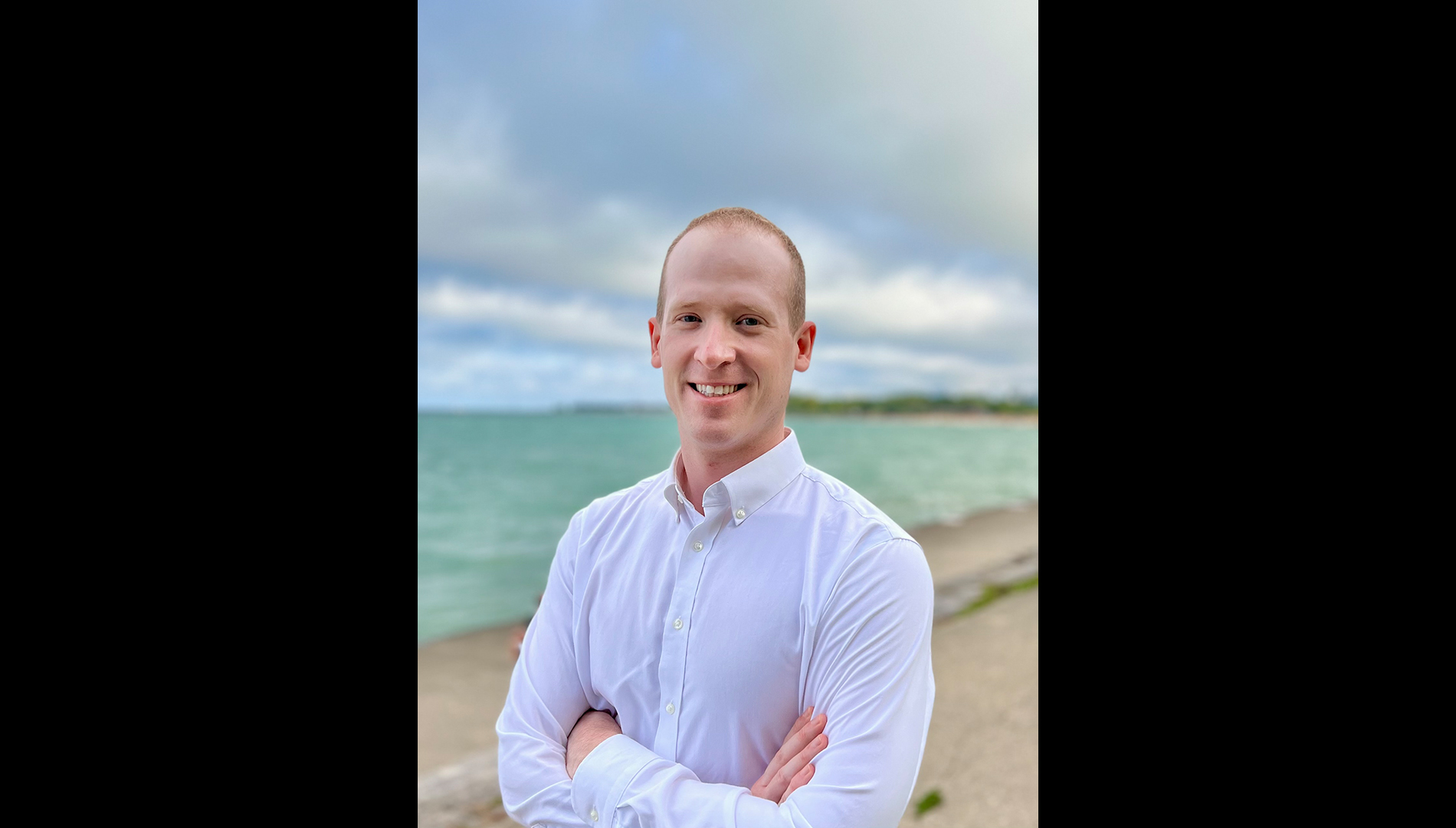
About the Candidate
Name: Isaac Freilich Jones
Date of Birth: Jan. 1, 1987
Occupation: Assistant Illinois Attorney General and public interest attorney
Political Experience: I have supported a variety of progressive political candidates over the years, worked on public policy related litigation as an Assistant Illinois Attorney General, and supported the work of the United State Senate Judiciary Committee while attending Harvard Law School.
Political Party: Democrat
Website: www.isaacfor48.com
Candidate Q&A
Why are you running?
I am running for alderperson to draw on my roots on the Far North Side and my proven record of leadership in public service to implement a progressive, independent vision that ensures the 48th Ward continues to be one of Chicago’s great neighborhoods where all are welcome, all are safe, and where no one is left behind.
I have a record of community-centered volunteerism and public service that will allow me to lead from day one:
• After graduating from Harvard Law School, I went on to become an Assistant Illinois Attorney General. I have kept Illinoisans safe by fighting to protect regulations that keep firearms off our streets, litigating to protect public health, and investigating fraud and misconduct by recipients of government funds. Illinois has trusted me to take its hardest cases, and I will bring that proven record of leadership and success to the work of defending the interests of our community.
• As a volunteer at Care for Real, an Edgewater Food Pantry, I learned first-hand that while we have an amazing and caring community, too many neighbors are being left behind. I am running for office to fight for every neighbor in our Ward, so that our entire community can benefit from everything our neighborhood has to offer.
• As Board President and volunteer at the Howard Area Community Center, I led a 100-employee nonprofit providing more than $5 million dollars in services per year on Chicago’s Far North Side. I know what it takes to lead a large, complex organization, how to successfully fight for funding for essential programming, and how to build coalitions of government agencies, businesses, and neighbors to serve the community.
• As a consultant at O-H Community Partners, a small mission-driven consultancy, I helped organize community engagement efforts that gave local Chicago residents a voice in planning and development processes, and helped manage a network of job training nonprofit organizations that collectively placed hundreds of people in good jobs. I have a proven record of running successful community engagement and community visioning processes, and would bring that deep experience to my work as 48th Ward alderperson.
Together, these experiences enable me to make progress on the 48th Ward community’s goals of ensuring public safety, fighting for housing affordability, revitalizing commercial corridors and filing empty storefronts, supporting seniors, and fully funding our schools, libraries, and parks.
What does this office do well, and what needs fixing?
The 48th Ward aldermanic office has done a good job addressing constituent needs, communicating with 48th Ward residents, and advocating for the community. As alderperson I will be to take what works about the 48th Ward office, and further evolve and improve in order to meet the needs of tomorrow even more effectively by:
• Expanding town hall meetings: Recently, our Ward has held a set of general topic town halls clustered together once per year. Going forward, I will hold a town hall each month at a variety of times and formats over the course of the year, to allow everyone who wishes to participate a way to do so on a more regular basis.
• Increasing approval process transparency: We have no central location for residents to learn about approval processes. I will increase transparency by posting information about zoning and permitting change requests, approval processes, and decisions on a public web portal.
• Implementing participatory budgeting: 48th Ward menu money has historically been allocated by the alderperson. I will implement a democratic, participatory budgeting approach to spending aldermanic menu money that will allow 48th Ward residents to vote on their priorities for neighborhood infrastructure investment.
What is the most pressing issue facing your constituents and how do you plan on addressing it?
Public safety is the most pressing concern of 48th Ward residents right now. In order to ensure that our city and community are safe, I will fight to implement a three-part public safety strategy.
First, we must reimagine law enforcement by moving away from models that do not yield results, and return to an approach that focuses on permanently stationing community-based foot patrol officers in our neighborhood.
Second, we must ensure that our built environment in the 48th Ward (and throughout the city) is designed to encourage safety. That means, for example, ensuring that every underpass is well-lit at night, that our streetlamps illuminate sidewalks and not just the centers of streets, and that our CTA facilities are designed and operated with safety in mind.
Third, we must address the root causes of violence by investing in jobs, education, economic-development, trauma recovery, mental health services, and strong communities. Because we live in one interconnected city, we must ensure that those investments happen city-wide, and particularly in communities on the South and West sides that have experienced decades of disinvestment and inequity.
What specific steps would you take to ensure your office is accessible and responsive to your constituents?
The 48th Ward deserves an aldermanic office that is responsive, accessible, and puts the needs of community first. I will therefore engage neighbors through:
• Weekly emails on community issues and events.
• Monthly town halls held in a variety of formats and times to accommodate all schedules.
• Special events to discuss issues of particular concern or interest as they arise.
• Frequent personal availability and “office hours” to connect with constituents.
• Attendance at community meetings held by others.
• Community visioning processes to plan on issues of concern (for example, focusing on housing affordability, or commercial corridor development and revitalization).
• Social media updates.
Because constituent services are the core duties of an alderperson, I will also make sure that my office responds effectively to specific requests. When our office receives a service request we will:
• Acknowledge receipt.
• Check in as necessary while a service request is being resolved.
• Follow up once we are informed that a request has been completed, to ensure that everything is satisfactory.
Finally, my office will make a particular effort to ensure our communications and events are accessible to all members of our community, including those with disabilities, and those who communicate primarily in a language other than English.
Do you believe in the tradition of aldermanic prerogative, which gives each City Council member the final say on issues in their ward?
We must achieve a better balance when it comes to the tradition of aldermanic prerogative. While an alderperson has a legitimate role to play in providing input and leadership on issues relating to local zoning and land use, aldermanic prerogative has also opened the door to corruption, abuses of power, and needless delays. In fact, misuse and abuse of aldermanic prerogative has factored into several recent investigations and prosecutions of alderpersons by federal authorities.
To remedy these issues, the City Council should consider at least the following reforms:
• Codify the procedures an alderperson must use if they wish to withhold approval for a project, so that every ward in Chicago can count on having a transparent, predictable process.
• Increase the role of the city’s central planning and zoning authorities when it comes to city-wide planning that cuts across ward boundaries.
• Move responsibility for permitting decisions relating to signage and other routine matters from alderperson offices to central City departments.
• Encourage alderpersons to hold each other accountable, and end the culture of impunity that has allowed some unscrupulous elected officials to abuse approval processes in their wards.
Should the $1.9 billion budget for the Chicago Police Department increase, stay the same or decrease?
The budget for the Chicago Police Department should stay about the same. However, the CPD budget should be used more effectively, and should be supplemented by funding that goes towards investments in under-served communities, restorative justice and social justice efforts, ethical economic development, and anti-displacement work.
To achieve our common goals for effective, constitutional law enforcement, and meet CPD’s obligations under the CPD consent decree, Independent Monitor Maggie Hickey has written that “CPD must recruit and hire the right people.” But to achieve that goal, Monitor Hickey has made clear that “CPD must continue to improve support services for its personnel and encourage positive behavior,” and “provide sufficient, high-quality training to all of its officers.” In order to meet these important benchmarks, we need to retain our current CPD budget, and spend it efficiently and effectively.
But real public safety requires much more than law enforcement — it requires that we build a city where all neighborhoods receive an equitable share of city resources, and where everyone has hope and opportunity, no matter who they are. That is why our public safety strategy must go beyond just funding law enforcement, and fund economic development and social justice programs city-wide.
Should the city raise the Real Estate Transfer Tax on properties sold for more than $1 million to fund programs to help unhoused Chicagoans?
I support the Bring Chicago Home ordinance, which proposes that the city raise the Real Estate Transfer Tax on properties sold for more than $1 million, with proceeds going to support housing programs. It is no secret that our city has a substantial need for housing services. During the most recent year for which data is available, according to the Chicago Coalition for the Homeless about 16,000 Chicagoans experienced sheltered or unsheltered homelessness, and almost 50,000 Chicagoans experienced homelessness by being forced to “double up,” couch surf, or stay with others because they lack housing of their own.
By establishing a dedicated revenue stream through Bring Chicago Home, we can begin to make progress on this important challenge in two ways. First, we will be able to expand the availability of services to those who experience homelessness by “doubling up,” intervening earlier with the aim of preventing them from ever ending up in a shelter or on the street in the first place. And second, we will be able to invest in efforts that rapidly rehouse those on streets or in shelters, and combine housing with wraparound social services that will give those without homes the chance to thrive.
Should the city open and operate mental health clinics to provide free care to Chicagoans?
Yes. The city must do a better job when it comes to ensuring an adequate supply of mental health care to Chicagoans.
First, the City should preserve and expand services offered at the five existing city-run mental health clinics. Second, the city should reopen the six mental health clinics that were closed under the Rahm Emanuel administration.Third, the city must expand its network of mental health clinics beyond just those that existed in 2015, opening additional facilities so that more neighborhoods have access to city-provided mental health services. Fourth, in parallel the city should move forward on plans to partner with community organizations and clinics already providing mental health services in our neighborhoods, providing additional funding and support for the important work these organizations do. And finally, the city should focus on the quality of service delivery, working diligently to reduce wait times for appointments, and continuously improve the quality of patient experience at City clinics.
How should Chicago build the 120,000 homes it needs for low- and moderate-income Chicagoans?
It is clear that Chicago’s housing stock is increasingly inadequate to meet the needs of Chicagoans, particularly seniors on fixed incomes, new high school or college graduates, and working people and families. An insufficient supply of housing that is affordable and accessible is one of the primary drivers of increasing housing costs for low- and moderate-income Chicagoans.
Because of the scale of the challenge, everything needs to be on the table if we are to make adequate progress. That is why I support using a combination of incentives for new market rate development, incentives for new affordable housing development, preservation of our existing affordable housing stock and preservation of reasonably priced middle-class housing, and regulatory changes that will expand the availability of housing, such as the legalization of accessory dwelling units.
What do you see as potential solutions to address the number of shootings in Chicago?
As an Assistant Illinois Attorney General, I faced off in court with NRA-aligned organizations that have sought to eliminate the firearm control laws that keep us safe. I know that addressing the epidemic of gun violence that has plagued our city must be among our highest priorities. While Chicago has strong gun control ordinances and rules in place, there is more we could be doing. That is why I support increasing the level of collaboration between the city and the State’s Attorney, the Office of the Illinois Attorney General, federal authorities, and nonprofits seeking to protect sensible firearm regulations.
It is also why I believe we must make sure that the Chicago Police Department’s Gun Investigations team has the resources they need to do their job. And finally, the City Council must continue to pass and enforce strong firearm regulations by ordinance, and be steadfast in defending those regulations even when they are challenged in court.
Should the city do more to encourage residents to live close to where they work and shop by building dense multi-unit apartment complexes near transportation hubs?
Yes, the city should make it easier for residents to live closer to where they work and shop by facilitating the construction of dense, multi-unit apartment complexes near transportation hubs. This pattern of development has the effect of reducing housing costs, reducing transportation costs, reducing the need to purchase cars and increasing the availability of parking, and reducing our city’s overall carbon footprint. That is why I support the implementation of the Connected Communities Ordinance, adopted by City Council in July of 2022, which will allow this pattern of development to become a reality.
Should the city prioritize the construction of bicycle lanes and encourage people to use bicycles to commute to work?
Yes, believe the city must prioritize the construction of bicycle lanes and encourage people to use bicycles to commute to work, because it would reduce traffic congestion, improve public health, and reduce air pollution, and because cyclists deserve infrastructure that protects them from harm.
As a native Chicagoan who has lived in this city for decades but never owned a car, I am acutely aware of the extent to which our streets are optimized for cars. Cycling in most areas of the city, and on most streets in the city, is not nearly as safe as it needs to be. Because Chicago has spent decades prioritizing the needs of automobile traffic when it comes to street and infrastructure design, the typical Chicago street exposes cyclists (and pedestrians) to significant safety risks each time they travel.
Because painted bike lanes alone do not provide adequate protection, I support additional protected bike lanes, and share the goals of the Chicago, Bike Grid Now! Campaign, which has called for a network of bike-prioritized streets that would be safer for cyclists, and safer for pedestrians.
What steps should the city take to prevent Chicago’s shoreline from eroding further?
Shoreline erosion is an area of acute concern in the 48th Ward, a lakefront neighborhood containing one of the few stretches of Chicago shoreline in which high density residential areas are immediately adjacent to Lake Michigan without any parkland to provide protection.
The city must commit to a long-term strategy, in partnership with state and federal authorities, to address shoreline erosion and flooding concerns. The first step in that strategy is already in progress: an Army Corps of Engineers study that will review the current conditions of endangered portions of Chicago shoreline, and recommend long-term interventions to address the challenge posed by erosion.
Because any permanent Corps of Engineers solution will take years to develop and execute, the city must also commit to implementing an interim strategy to take us through the next few years. As part of this interim the City should (a) maintain existing erosion mitigation infrastructure; (b) evaluate the expanded use of riprap (boulders designed to stop erosion), coir logs (which reduce erosion by encouraging plant growth), temporary concrete embankments, and sandbags where appropriate; and (c) work with the Water Reclamation District to mitigate storm runoff that could add to our erosion challenges on the lakefront.